

Shipping Container Water Treatment: How Containerized Systems Work
A shipping container water treatment system brings treatment equipment together inside a transportable enclosure. The container is only the shell: the treatment process, water source, intended use, utilities, and site conditions determine what equipment belongs inside. Planning those pieces together helps project teams avoid a layout that is hard to operate or maintain.
What does shipping container water treatment mean?
Containerized water treatment describes equipment arranged in a shipping container or a modified container enclosure. Depending on the project, the equipment may treat water for drinking, process use, site operations, or another defined purpose. A container can provide a weather-protective, movable space for equipment, but it does not make water safe by itself. The treatment process must be selected and validated for the source water and the water quality required at the point of use.
That distinction matters. A potable-water project and an industrial process-water project can have different source conditions, treatment goals, monitoring needs, and approval paths. Wastewater treatment is another distinct application. Before discussing the container, document what water enters the system, what quality is needed at its outlet, how much water must be handled, and who is responsible for operating it.
Container selection is therefore one part of a wider project, not a substitute for process design. A qualified water-treatment professional should determine the treatment train, equipment sizing, monitoring approach, and any applicable water-quality requirements. The container fabricator or supplier can then coordinate the enclosure and modifications against the reviewed equipment layout.
It helps to separate three decisions that are sometimes bundled together. First, the treatment designer determines the process and equipment based on the water and the required outcome. Second, the project team determines how operators will access, monitor, and service that equipment. Third, the enclosure team works out the container dimensions, openings, environmental features, delivery, and placement. Keeping those responsibilities clear makes it easier to identify missing information and avoid treating an enclosure choice as a process guarantee.
What should the project team define first?
Start with a written project basis. It gives the treatment designer, container team, utility providers, and site reviewers a shared reference. It also makes it easier to compare proposals that may use different equipment arrangements.
Water source:
Identify whether the source is municipal supply, groundwater, surface water, or another feed. Provide available source-water test results and note known seasonal or operational changes.
Intended use:
State whether the treated water is for drinking, a manufacturing process, cleaning, irrigation, or another use. Avoid describing a system as potable unless the responsible professional confirms the design and required verification.
Demand and operating pattern:
Describe expected use, peak periods, and whether demand is continuous, intermittent, or seasonal. The process designer needs these inputs to evaluate the system.
Outlet goals:
Define the water quality or process outcome required. The project team should identify who sets those requirements and how compliance or performance will be checked.
Operating model:
Determine who will start, stop, inspect, clean, and maintain the system, and what training or service support they need.
Site and mobility:
Clarify whether the unit will stay in one place, be relocated, or be delivered to a temporary site. A movable enclosure still requires a suitable route, foundation or support, and utility connections.
When source information is incomplete, record the gap rather than guessing. For example, a team might know the source is a well but have no recent test results, or know the average demand but not the peak requirement. Those are questions for the water professional to resolve. A list of assumptions also helps reviewers see which choices are provisional and what new information could change the equipment layout.
For an initial enclosure conversation, Mann's Cans describes its shipping container solutions and different container applications. The company also provides information about modified shipping containers. Those resources can help frame the container-side discussion; they do not replace treatment engineering or site approval.
How are treatment equipment zones arranged?
A workable layout groups equipment by function and preserves clear routes for operation and service. The actual arrangement is project-specific, but teams often consider the following zones. They may be separate areas in one enclosure or arranged as a sequence along the container's length.
Inlet and pretreatment:
The incoming-water connection, isolation points, and any early-stage equipment identified by the treatment designer. The location should allow operators to reach valves and inspect connections without moving unrelated equipment.
Main treatment:
The core process equipment selected for the source and intended use. Its connections, controls, service clearances, and replacement needs should be considered before fixing the enclosure layout.
Post-treatment and outlet:
Any final process steps, monitoring points, and treated-water connection specified by the designer. Keep the route from the process to the outlet understandable and accessible.
Controls and electrical equipment:
Panels, sensors, and control devices need a suitable environment and safe working access. Coordinate their location with cable routes, equipment doors, and maintenance tasks.
Consumables and service items:
If the process requires filters, treatment media, chemicals, or replacement components, plan for storage and handling as directed by the responsible professional. Do not use the remaining aisle as an afterthought storage area.
Make a plan view and a simple equipment schedule early. Mark the footprint of each major item, its connection points, access doors, and the space needed to remove a component. A layout can look adequate on paper but fail when a technician needs to pull a filter housing, open a panel, or reach a shutoff. Ask the equipment supplier for service-clearance and handling information before the container is modified.
Consider how people move through the enclosure. An operator should be able to reach routine inspection points without stepping over hoses or obstructing another service task. Keep emergency exits and access doors clear. If the equipment arrangement creates a confined or hazardous work condition, the project team must address that through qualified safety and engineering review rather than relying on the container layout alone.
A practical way to test a proposed plan is to trace a typical workday. Mark the route an operator takes to check an inlet reading, inspect the process equipment, review a control panel, and record an outlet result. Then trace a less frequent task, such as replacing a component or cleaning a designated area. If either route crosses a removal path, blocks a valve, or requires moving another piece of equipment, revise the layout before fabrication. The drawing should show more than equipment footprints: include doors, aisle space, working positions, and the direction large parts need to move.
Also think about separation of clean and service activities where the process requires it. The designer may specify sampling points or handling practices that influence where a sink, work surface, or supplies belong. Do not assign these locations from a generic template. Confirm them with the professional responsible for the treatment process, then coordinate any needed penetrations and fixtures with the enclosure plan.
How do access and maintenance shape the enclosure?
Access planning is part of system design. List routine, periodic, and corrective maintenance tasks, then check each task against the actual equipment position. For every item, ask whether an operator can inspect it, isolate it, clean it, and remove parts that wear out. Include space to bring replacement parts in and old components out.
Doors and openings should be coordinated with the largest equipment that must pass through them. A piece of equipment that fits inside during fabrication may be difficult to replace later if the available route is too narrow or blocked. The project team should confirm delivery dimensions and removal paths with suppliers before approving the final arrangement.
Also identify what must remain outside. Bulk storage, backup equipment, waste handling, or a separate control area may not belong in the same enclosure. If operators need to use chemicals or perform specialized tasks, consult the treatment designer and safety professionals about handling, ventilation, separation, and required protective measures. Do not infer those needs from the container's size alone.
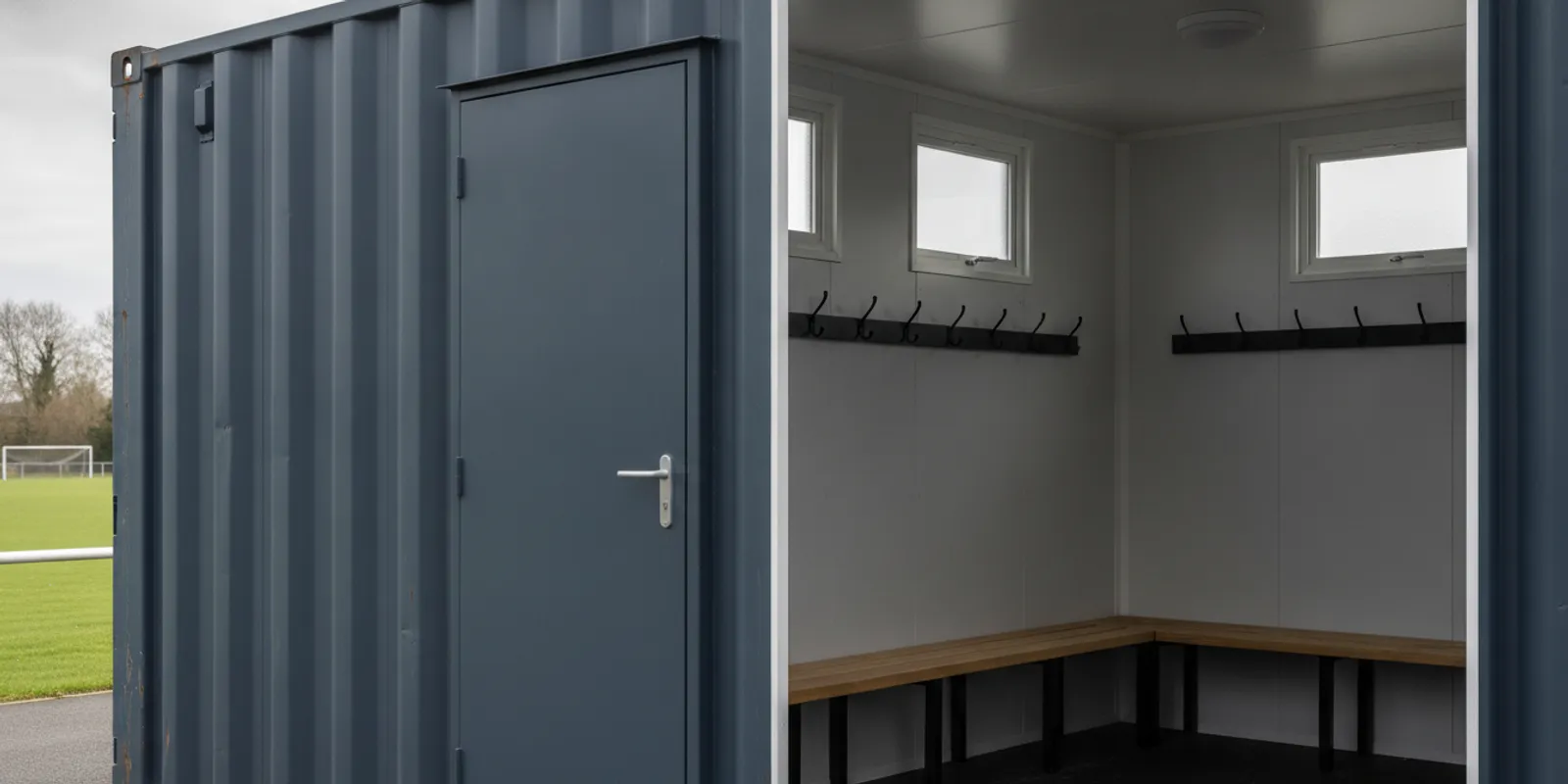
A container can be modified with doors, windows, partitions, or utility penetrations, but each opening affects the enclosure and must be coordinated with structural requirements. Mann's Cans shares examples in its container project gallery. For a treatment installation, the equipment and opening plan should be reviewed before fabrication begins.
Build a maintenance matrix as a companion to the layout. One column can list each task; other columns can identify who performs it, how often the equipment supplier or designer expects it, what access is needed, and whether the system must be isolated first. Leave task frequency and procedures to the responsible professionals, but make sure the physical plan supports them. For example, a panel may be easy to reach during normal operation yet impossible to open fully when a nearby pump is installed. A matrix makes that conflict visible while there is still time to change the arrangement.
Think through consumables and removed parts as well. A replacement filter, treatment media container, or tool kit needs a designated route into the enclosure and a sensible temporary staging location. The route out matters too: service work should not require carrying a wet or used component past sensitive controls or through a narrow space with no safe handling plan. Ask equipment suppliers which items are replaced as assemblies and what dimensions or lifting methods they require.
Which utilities and environmental conditions need review?
Prepare a utility list for the treatment designer and site team. Depending on the selected process, a project may need electrical power, water connections, drainage, communications, or other services. Do not assume that a standard container includes those connections or that a nearby connection has enough capacity. Confirm each service with the relevant utility provider and qualified installer.
Electrical service:
Document the equipment loads and control requirements supplied by the equipment designer. Have qualified electrical professionals determine the service, distribution, protection, grounding, and installation requirements.
Drainage and discharge:
Identify where backwash, cleaning water, process residuals, or other discharges would go if the process produces them. The project team must determine whether collection, treatment, permits, or other controls are needed.
Water connections:
Coordinate inlet and outlet locations, isolation, and any sampling or monitoring points with the treatment design. Confirm how hoses or fixed piping connect without creating trip hazards or interfering with access.
Communications and alarms:
Determine whether remote monitoring, alarms, or data recording are needed, and confirm the infrastructure and responsible operator.
Heat, cold, and moisture:
Review the operating environment and equipment limits. Insulation, heating, cooling, ventilation, or condensation management may be needed, but choices depend on the equipment and climate conditions.
Temperature control should not be treated as a generic add-on. Equipment may have specific environmental limits, and changing airflow can affect dust, moisture, or process conditions. Ask the equipment supplier and enclosure designer to coordinate insulation and HVAC needs against the heat load, outside climate, and maintenance access. Treat climate control as a separate design question and coordinate it with the equipment supplier and enclosure designer.
Water storage also deserves a separate plan. The CDC's safe water storage guidance describes cleaning and sanitizing a storage container. Apply storage practices appropriate to the system and intended use, and have the responsible water professional specify any project-specific requirements. Treatment, storage, and distribution must work as a coordinated chain.
Make a utility schedule that connects each requirement to a responsible party. For example, list the connection, the information still needed from the equipment supplier, who will confirm site capacity, and who will install or inspect it. This is more useful than a generic note that the enclosure needs power or drainage. It can reveal early that a planned service enters on the wrong side of the container, conflicts with the door swing, or cannot be reached after placement.
Consider how the enclosure will behave during both normal operation and service. Moisture from cleaning or process activity, condensation on surfaces, and heat from equipment may affect controls and materials. The right response is specific to the equipment and operating environment. Have the relevant designers establish what conditions must be maintained, where sensors belong if needed, and how any ventilation or climate-control equipment can be inspected without interrupting safe access.
How do delivery and site approvals affect the plan?
Before selecting a final container location, confirm the delivery route and the space needed to place it. Review turning room, overhead obstacles, ground conditions, access for the delivery vehicle, and any restrictions on the site. A container that can be unloaded at the property entrance may still be unable to reach its intended pad. Mann's Cans explains container moving and delivery considerations; the specific site and equipment must still be assessed for the project.
Site preparation and approvals should be discussed early, not after the enclosure is built. Depending on location and use, the project may need review of land use, building or fire requirements, electrical work, plumbing, drainage, water quality, or environmental discharge. Requirements vary by authority and project. Contact the relevant local officials and qualified design professionals to establish the approvals that apply; do not assume that a container is exempt because it can be transported.
Plan the placement surface and utility routes alongside the treatment layout. A level, stable support and safe access for operators are important planning considerations, but the appropriate foundation or anchoring must be determined for site conditions and applicable rules. Keep valves, service doors, and utility connections reachable after placement. Account for snow, rain, standing water, and seasonal site access where relevant.
Transport can also affect equipment selection and assembly. The design team should identify what can travel installed, what must be secured or protected, and what requires commissioning after delivery. A move may affect pipework, electrical connections, calibration, or process settings. Qualified personnel should determine the inspection and restart procedure after relocation.
Use a site walk-through to turn general concerns into measurements and decisions. Note the proposed container orientation, the approach route, overhead clearance, locations of existing services, and the space available for doors to open. Mark where operators will stand while connecting utilities or performing routine checks. If the unit might be moved later, document alternate placement areas and the route to them rather than assuming future access will be identical.
Approvals can involve different reviewers for different parts of the project. A local authority may address placement or construction requirements, while other qualified parties review electrical work, water quality, or discharge. Ask who is responsible for each review, what drawings or details they need, and whether approval is needed before purchasing or modifying the enclosure. Keep written responses and design revisions with the project records so the team can track which layout was reviewed.
How can you compare containerized system approaches?
The comparison below is a planning aid, not a specification. The treatment professional should determine which process and equipment meet the project's water-quality and operating requirements. A container provider can then discuss enclosure fit, access, and modifications.
Planning approach | What it helps organize | Key questions to resolve |
Single enclosure, one process line | A compact arrangement with equipment grouped in a defined sequence | Can operators reach every service point? Is there adequate space for removal and safe access? |
Single enclosure, separated work zones | Distinct areas for process equipment, controls, or operator tasks | Do partitions and doors preserve required clearances, airflow, and access? |
Multiple enclosures or modules | Separation of functions or staged transport and installation | How will modules connect on site? Are utility routes, weather protection, and commissioning coordinated? |
Container with external equipment | Indoor enclosure space reserved for selected equipment, with other components located outside | Are exposed components protected, accessible, and permitted? Do connections work across the site layout? |
Compare approaches against a common checklist: treatment goals, source-water information, operator tasks, equipment access, utility requirements, site footprint, transport, approvals, and future maintenance. Do not compare only by container dimensions. A smaller footprint is not an advantage if it restricts safe service access or prevents equipment replacement.
Each approach shifts coordination work in a different way. A single enclosure may simplify the overall footprint but can concentrate equipment, utilities, and maintenance tasks in a confined area. Separate zones or multiple modules may make functions easier to distinguish, yet add interfaces that need connections, weather protection, and commissioning. Equipment placed outside can free interior room, but then exposure, access, security, and site clearances need attention. Ask the project team to explain how each option affects both routine operation and the less frequent task of repair or replacement.
To understand the differences among enclosure sizes and configurations, review Mann's shipping container types guide. For a project-specific enclosure conversation or to share preliminary site details, use the contact page.
What should you prepare before requesting a container quote?
A useful inquiry includes enough detail to identify the enclosure and delivery questions without pretending that the treatment design is complete. Assemble the following information where available:
A short description of the application and intended treated-water use.
Available source-water information and the treatment professional's preliminary process or equipment layout.
Overall equipment dimensions, weights, connection points, and access or removal clearances.
Utility needs provided by the equipment designer, including electrical and drainage requirements.
Any known indoor-environment needs, such as operating temperature limits or moisture considerations.
The proposed site address or general area, placement location, delivery access, and known site constraints.
Whether the enclosure will remain in place or may need to move, and what commissioning support the system team anticipates.
Known approval discussions and the professionals or authorities responsible for reviewing the project.
One helpful way to organize this packet is to label each item as confirmed, preliminary, or unknown. A confirmed equipment dimension can guide a layout; a preliminary process choice should be flagged as subject to the treatment designer's review. Unknown utility capacity or site access should become an action item with an owner. This simple status system reduces the chance that an early drawing will be mistaken for a final design.
If plans are preliminary, label assumptions clearly. A quote based on an early footprint may change after equipment selection, site review, or approval requirements are confirmed. Mann's Cans offers information about its container ordering and project questions; bring technical process questions to the qualified water-treatment designer.
Frequently asked questions
Does a shipping container make water safe to drink?
No. The container is an enclosure, not a treatment process. A qualified water-treatment professional must specify and verify a system designed for the source water and applicable drinking-water requirements.
Can any treatment equipment fit inside a standard container?
Not necessarily. Fit depends on equipment dimensions, service clearances, connection routes, access openings, and environmental conditions. Develop a layout with equipment suppliers and the enclosure designer before selecting or modifying a container.
Can the treatment system be moved after installation?
Possibly, but relocation requires planning. The project team should determine how equipment, piping, electrical connections, and controls are secured for transport, and who will inspect and recommission the system at the new site.
Does a containerized water treatment project need permits?
It may. Requirements depend on the location, use, installation, utilities, and discharge, among other project details. Ask local authorities and qualified professionals which approvals apply before ordering or placing the enclosure.
What is the safest next step?
Define the water source, intended use, treatment goals, operating plan, equipment layout, and site conditions with qualified professionals first. Then coordinate the container, modifications, delivery, utilities, and approvals around that reviewed plan so the enclosure supports the treatment system rather than limiting it.

Comments