

Updated: Oct 14

Shipping Container Wind Load: A Practical Guide
Wind planning for a shipping container starts with the site, not a single number printed on a chart. Exposure, placement, container configuration, intended use, local requirements, and the condition of the ground can all affect what questions need to be answered before delivery or modification.
Shipping container wind load is the wind force a specific installation may need to resist, based on its location, exposure, configuration, and use. It is not a universal rating for every container. For project-specific decisions about anchoring or structural design, consult the local authority having jurisdiction and a qualified design professional.
Before getting into anchoring or engineering questions, it helps to define what wind load means and why a container's surroundings matter as much as the container itself.
What Does Shipping Container Wind Load Mean?
Shipping container wind load is the force that moving air can apply to a container, its walls, roof, doors, and any attached or modified parts. That force matters because a container is not evaluated in isolation. Its response can depend on where it is placed, how it is oriented, what surrounds it, how it connects to the ground, and how it will be used.
In practical terms, wind load is a site-specific design question, not a single rating that applies to every container. A container in a sheltered location may face different conditions from one in open terrain or on an exposed ridge. Local requirements may also change based on the proposed use and the authority having jurisdiction. An Oklahoma government code amendment, for example, ties container wind design provisions to stated conditions rather than presenting one universal container rating: read the code example.
That distinction is important when comparing online claims. Wind-resistance figures can vary between sources, but those figures should not be treated as a guaranteed design value for a stationary installation. Mann's Cans does not publish universal wind-load ratings for its container sizes. A service inspection of frame integrity or corner castings is useful condition information, but it is not a wind rating or structural engineering certification.
A CSC plate also should not be treated as proof that a container meets stationary-building wind requirements. It relates to intermodal transport considerations, while a long-term installation may involve separate local code, foundation, anchoring, and use questions. For a helpful distinction between container condition categories, see this guide to wind-and-watertight container condition.
For a project-specific determination, provide the local building official or a qualified design professional with the site, intended use, container configuration, modifications, and placement details. Mann's Cans can help with container options and delivery planning, while engineering and code decisions remain specific to the project.
Why Does Site Exposure Matter So Much?
A container placed in an open field may experience different wind forces than one partly sheltered by buildings, trees, or other terrain. That does not create a universal rating for the container. It means the surrounding site is part of the question whenever someone evaluates shipping container wind load.
Orientation can matter because the container presents different surfaces to prevailing winds. Elevation, slopes, ridgelines, and nearby open areas may also change how wind reaches the installation. Even a nearby structure or windbreak should be treated as a site consideration, not an automatic solution. The authority having jurisdiction and a qualified design professional can determine which conditions apply to a particular project.
Site access affects planning before the container arrives
Exposure is only one part of a practical site review. Delivery planning also looks at the access route, turning and overhead clearances, utility lines, obstacles, and the area where the container will be placed. These details help identify whether the proposed location is workable for delivery and whether additional site questions need attention before scheduling.
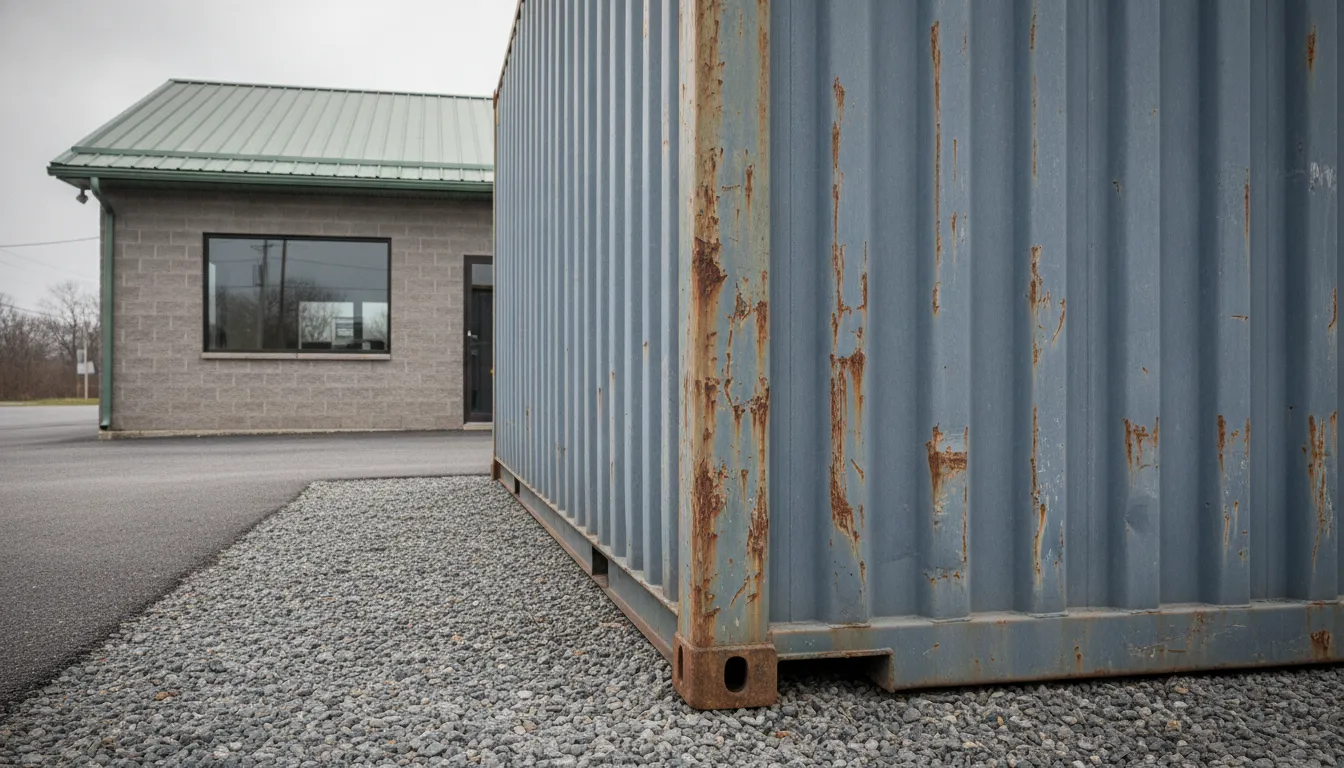
Ground conditions deserve the same care. A location that is level, accessible, and prepared for drainage can support more predictable placement than soft, uneven, or poorly drained ground. Preparation may involve considering a suitable gravel pad or block placement, but the correct approach depends on the container, site, use, and local requirements. It should not be treated as a universal wind-design prescription.
For practical planning, review Mann's Cans storage container placement and preparation options alongside the Pennsylvania snow-load and winterizing guide. Snow, drainage, wind exposure, and local code questions can overlap, while the final project-specific determination belongs with local officials and qualified professionals.
Which Container and Site Details Affect the Review?
A useful review starts with the actual container and the place where it will be used. A 20-foot standard unit, a 40-foot high-cube unit, and a modified container may present different questions. Mann's Cans can help discuss available container options and delivery logistics, but wind resistance and anchoring remain project-specific questions for the loc
Size and configuration. Length, height, condition, and configuration are inputs to the review. They do not create a universal wind rating. Question to confirm: Which container type, dimensions, and configuration are proposed for this use?
Frame and corner castings. Frame integrity and corner-casting condition are important condition checks. An inspection is not an engineering certification. Question to confirm: Have the frame and corner castings been inspected, and what condition was documented?
Openings and modifications. Doors, windows, cutouts, and other changes can affect how forces move through the container. A qualified review may be needed before modification. Question to confirm: What openings or modifications exist, and were they reviewed for this intended use?
Contents and interior use. Contents may affect the overall situation, but stored weight is not a substitute for engineered restraint or a site-specific determination. Question to confirm: What will the container hold, and will the contents change during seasonal or operational use?
Placement and surroundings. Access, levelness, drainage, obstacles, utilities, nearby structures, and exposure can change the review. Question to confirm: Where will it sit, how will it be delivered, and what conditions surround the site?
Local rules and approvals. Requirements can vary by municipality, use, and site. Local officials and qualified professionals determine what applies. Question to confirm: Which building official or authority having jurisdiction should review this project?al authority and qualified design professionals.
Gathering these details early can make conversations more productive. For practical preparation, review storage container placement and preparation guidance, then take project-specific code and structural questions to the appropriate professionals.
How Should Shipping Container Anchoring Be Evaluated?
Anchoring is not a decision that can be made from container length, width, or height alone. A site-specific review should consider the container's use, configuration, condition, exposure, placement, and the requirements of the local authority having jurisdiction. The same container may face very different project questions on a sheltered residential lot than on an open commercial site.
Look at the complete attachment path
At a high level, the review should follow the potential force from the container through its connection points and into the supporting ground or foundation. That means considering how the container is positioned, how any proposed restraint would attach, and whether the supporting surface is appropriate for the intended use. An attachment that looks substantial in isolation does not answer whether the full path transfers forces as intended.
This is also why container size should be treated as one input, not a shortcut to a prescribed anchoring approach. Openings, modifications, stacking, uneven placement, drainage problems, and changing ground conditions can all affect the questions a qualified professional needs to answer. A service inspection of frame integrity or corner castings is useful for understanding container condition, but it is not a wind rating or engineering certification.
Evaluate the ground interface and local requirements
The ground interface deserves the same attention as the container connection. Site preparation may involve access, levelness, drainage, security, and local zoning considerations. Mann's Cans provides general placement and delivery guidance, while local officials and qualified design professionals determine project-specific code, foundation, and anchoring requirements. See this Pennsylvania container foundation guidance for related planning considerations.
Do not treat a CSC plate as proof that a container meets stationary-building wind requirements. For a project involving unusual exposure, a modified container, a permanent structure, or a formal permit review. Gather the site and use details before asking the authority having jurisdiction or a qualified professional for direction.
How Do Modifications, Contents, and Stacking Change the Question?
A standard container is one thing to review; a container with large openings, added doors, windows, attached equipment, or other changes may require a different conversation. Removing or interrupting portions of a wall can affect how forces move through the structure. That does not mean every modification creates a problem, but it does mean a general shipping container wind load discussion cannot be separated from the container's actual configuration.
One Oklahoma government code example shows why this review can become detailed. Its provisions address limits on the total length of openings. Wall portions that may not count as part of a lateral force-resisting system, and boundary elements that create a continuous load path. Those are code-specific provisions, not Pennsylvania requirements or a design instruction for your project. They illustrate why substantial changes should be reviewed by the authority having jurisdiction and a qualified design professional. For background, see our guide to container modifications and structural review.
Contents add context, not a complete restraint plan
Contents can change the overall condition of a container, but filling it with equipment, materials, or inventory is not a substitute for engineered restraint. Weight, distribution, movement, access, and the way items are secured are separate questions from how the container connects to the site. A full container should not automatically be treated as a wind-rated installation, and an empty container should not be judged from a universal wind figure.
Condition matters as well. A service inspection of frame integrity and corner castings can provide useful product information, but it is not a wind rating or engineering certification. Likewise, a cargo-worthy designation addresses transport-related condition and should not be treated as proof of stationary-building wind compliance. Our guide to wind-and-watertight container condition explains that distinction.
Stacking is a separate design question
Stacking changes the load path, connection points, access, and stability questions. It should not be assumed to follow the same review as a single container placed on the ground. Rules may also vary by jurisdiction and proposed use. Read our overview of container stacking considerations, then take project-specific questions to local officials and qualified professionals before treating a stacked arrangement as an approved design.
What Local Codes and Permits Should You Check?
Before delivery or conversion, treat local approval as a project question, not a universal container rule. Requirements can change with the container's intended use, placement, modifications, and the authority having jurisdiction (AHJ). Portland and Long Beach provide useful examples of that variation, but their guidance is not Pennsylvania law.
- Which authority having jurisdiction should review the project?
Start with the municipality, county, or other local building and planning office responsible for the property. Ask which departments need to be involved and whether zoning, building, land-use, or other agency review applies. Local officials, not a general online article, determine the requirements for your site.
How will the container be used?
Explain whether it will remain storage, support a business or agricultural operation, or be converted into a room, office, or other occupied space. Portland's
shows that containers used as structures must meet applicable building and zoning requirements, while limited storage pathways can have conditions.
- Where will it be placed?
Confirm setbacks, lot coverage, access, utilities, drainage, ground preparation, and whether the location creates additional site or zoning questions. Placement and use should be reviewed together, especially if the container will be near property lines, structures, or public access areas.
Which permits or approvals are required?
Ask for the exact permit names and application sequence before scheduling work. A Long Beach
treats repurposed containers as new construction for applicable requirements and describes possible land-use, construction, and other agency approvals. That is an example of jurisdictional variation, not a Pennsylvania requirement.
- Are engineering documents or other technical submittals needed?
Ask whether the proposed wind load, anchoring, foundation, modifications, stacking, or load path requires drawings, calculations, or review by a qualified design professional. Do not assume a CSC plate, container size, or product description establishes stationary-building wind compliance.
What inspections or follow-up questions apply?
Confirm whether the project needs a pre-delivery site check, foundation or anchoring inspection, framing inspection, or final approval. Mann's Cans can discuss container options and delivery logistics, but project-specific code and engineering determinations belong with the AHJ and qualified professionals. For planning help,
contact Mann's Cans about delivery and site logistics
.
A Practical Pre-Delivery Wind-Planning Checklist
Before delivery, gather the information a local building official or qualified design professional may need to evaluate your project. A clear site summary can make the conversation more productive and help separate ordinary delivery planning from questions about shipping container wind load.
- Location:
Record the property address, municipality, intended placement area, and whether the site is open, sheltered by nearby buildings or trees, elevated, or otherwise exposed.
- Use:
Describe whether the container will serve as storage, a work area, an accessory space, or another application. The proposed use can affect local requirements.
- Dimensions and configuration:
Note the container length, height, number of units, orientation, and whether you are considering stacking or other unusual arrangements.
- Condition and modifications:
Identify whether the unit is new or used, along with doors, windows, cutouts, insulation, welded additions, or other changes. A service inspection of frame integrity and corner castings is not a wind rating or engineering certification.
- Access:
Review the delivery route, turning space, overhead and side clearances, utility lines, obstacles, and the straight clearance needed for the delivery equipment.
Ground and drainage:
Gather information about soil, slope, levelness, drainage, the proposed pad or support arrangement, and any accessibility or security concerns.
Storage container placement and preparation
can help organize these practical questions.
- Local requirements:
Ask the authority having jurisdiction about zoning, permits, setbacks, inspections, and whether stamped engineering documents or project-specific anchoring review are required.
Mann's Cans can help discuss container options, delivery access, and site logistics in its Pittsburgh-area service region. Those conversations do not replace an official determination or qualified professional's decisions about exposure, foundations, anchoring, or structural design. For delivery planning, contact Mann's Cans with the site details you have gathered.
Frequently Asked Questions
How much wind can a shipping container withstand?
There is no single wind rating that applies to every container in every location. Wind effects depend on exposure, orientation, placement, condition, modifications, contents, anchoring, and the applicable local requirements. Treat online wind figures as general discussion, not a design value. For a project-specific determination, consult the authority having jurisdiction and a qualified design professional.
What is 20 psf wind load?
Twenty pounds per square foot, or 20 psf, describes a pressure used in some structural design contexts. It is not a universal rating for a shipping container, and it should not be used as a DIY calculation for anchoring or placement. The applicable pressure and load path depend on the site, proposed use, container configuration, and local code requirements. See the example government code text for why project conditions matter.
What is the maximum load for a 20ft and 40ft container?
Container length alone does not establish a maximum wind load or safe stationary-building capacity. Size and configuration are inputs for a site-specific review, while condition, openings, modifications, ground interface, and local requirements also matter. A service inspection can identify frame or corner-casting concerns, but it is not a wind rating or engineering certification.
Can a tornado flip a shipping container?
Severe wind can move or overturn an empty or lightly loaded container, but the outcome depends on the event and the installation. Contents are not a substitute for engineered restraint. Do not assume that a container, its CSC plate, or its weight makes it a storm shelter or proves stationary-building wind compliance. Discuss project-specific protection with local officials and qualified professionals.
Frequently asked questions are answered above.
Ready to Plan Your Container Project?
Wind planning starts with understanding the container, the site, and the delivery conditions together. Mann's Cans can help you discuss suitable container options, access considerations, and site logistics before you move forward. For project-specific code or structural questions, involve your local authority and a qualified design professional.


Comments